



Digital twins are moving rapidly from niche technology to a central tool for business innovation. From factory floors and operating rooms to autonomous vehicles and global enterprises, the technology is shifting from experimental pilots to scalable, revenue-generating systems.
The Mack Institute’s Fall 2025 Conference, Digital Twins 2.0: Making the Invisible Visible, brought together business practitioners and researchers from Wharton, Penn Engineering, and Penn’s Weitzman School of Design to examine how digital twins are creating real value. Throughout the daylong event, speakers explored how digital twins can cut costs, unlock new operational efficiencies, and surface the hidden signals that shape strategic advantage.
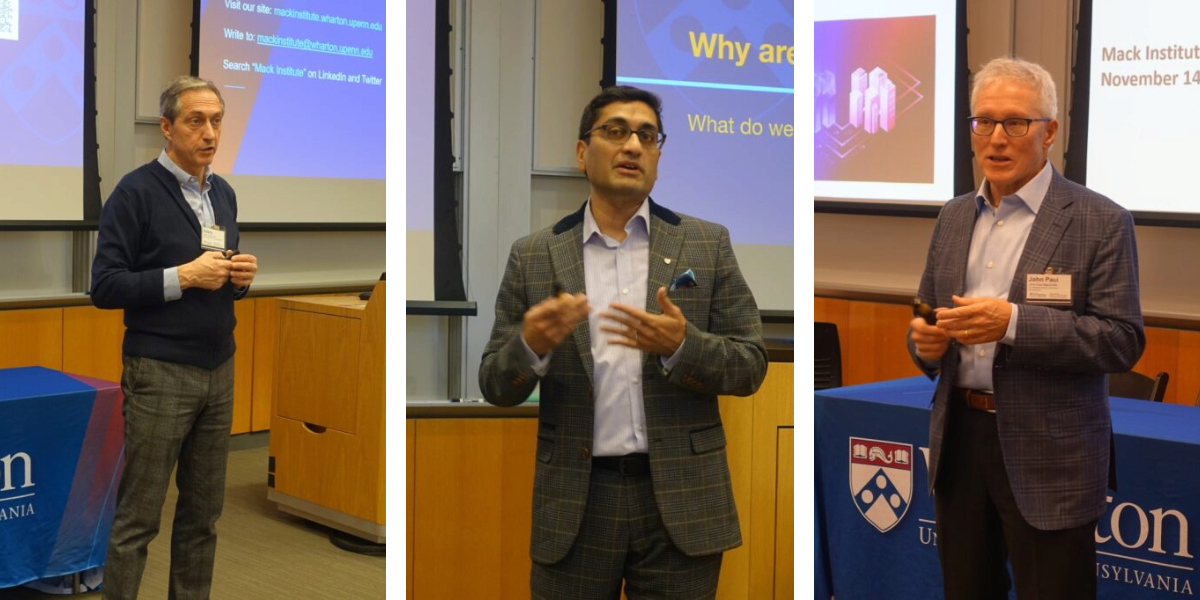
“Digital twins are diffusing rapidly, anchored in pre-AI technologies and the power of visualization,” said Wharton Professor John Paul MacDuffie. “Yet they still have with much further to go to reach their potential for providing dynamic operational intelligence for the complex systems that underpin modern economics and daily life.”
“The main reason for organizing this conference was to understand how digital twins are designed for purpose, deployed in operations, and engage the organization throughout its lifecycle,” explained co-organizer Professor Rahul Mangharam of Penn Engineering. “By bringing together industry leaders across automotive, manufacturing, logistics, energy, supply chain, and urban planning, we learned how digital twins enabled organizations continuously learn and respond to shifting market conditions in real time.”
Defining Digital Twins
A recurring theme throughout the conference was the challenge of defining what, exactly, qualifies as a digital twin. As MacDuffie noted in his opening remarks, participants were unlikely to agree on a single definition, a fact which reflected the diversity of industries, data types, and modeling approaches represented in the room.
MacDuffie anchored the conversation in a definition from the National Academy of Sciences report Foundational Research Gaps and Future Directions for Digital Twins, which several speakers referenced throughout the day. According to this definition, a digital twin is:
- a virtual representation that mirrors a physical system’s structure, context, and behavior;
- enables real-time, bidirectional data flow;
- influences and is influenced by a physical system;
- and evolves continuously over its lifecycle to support planning, forecasting, and ongoing operation
Yan Lu, Deputy Division Chief of System Integration at the National Institute of Standards and Technology (NIST), added further precision by drawing on ISO 23247, one of the few domain-specific standards now emerging. She emphasized that a digital twin must be:
- “fit for purpose,” serving a real operational need;
- observable, meaning grounded in synchronized data from the physical system;
- distinct from a digital model or digital shadow, neither of which are bidirectional
- reusable across products, lifecycle stages, and systems-of-systems.
Across the day’s discussions, a consensus emerged that digital twins should be viewed as a spectrum, not a single technology. Organizations need to define for themselves the type of twin that matches their purpose, desired fidelity, and the degree of real-time interaction between the physical and virtual worlds.
Digital Twins Use Cases
Throughout the day, speakers presented a wide range of digital twin applications, illustrating how these models are built, how they create value, and where they are beginning to scale. For clarity, we have grouped the examples discussed at the conference into three categories (Place-Based Twins, Mobility and Autonomy Twins, and Industrial Operations and Supply Chain Twins) and summarized representative cases in the sections that follow.
This list is not exhaustive; it reflects only the use cases highlighted during the event. Several important domains—such as clinical and biomedical twins, advanced energy-system twins, and next-generation workforce and training applications—were mentioned but not covered in depth.
Place-Based Twins: Modeling Buildings, Cities, and the Earth
One major category discussed was digital twins anchored to specific places, from individual buildings to entire cities and even the planet. These place-based twins integrate spatial data, environmental variables, and contextual conditions to support real-time monitoring, predictive analytics, and strategic planning.
Planetary/climate
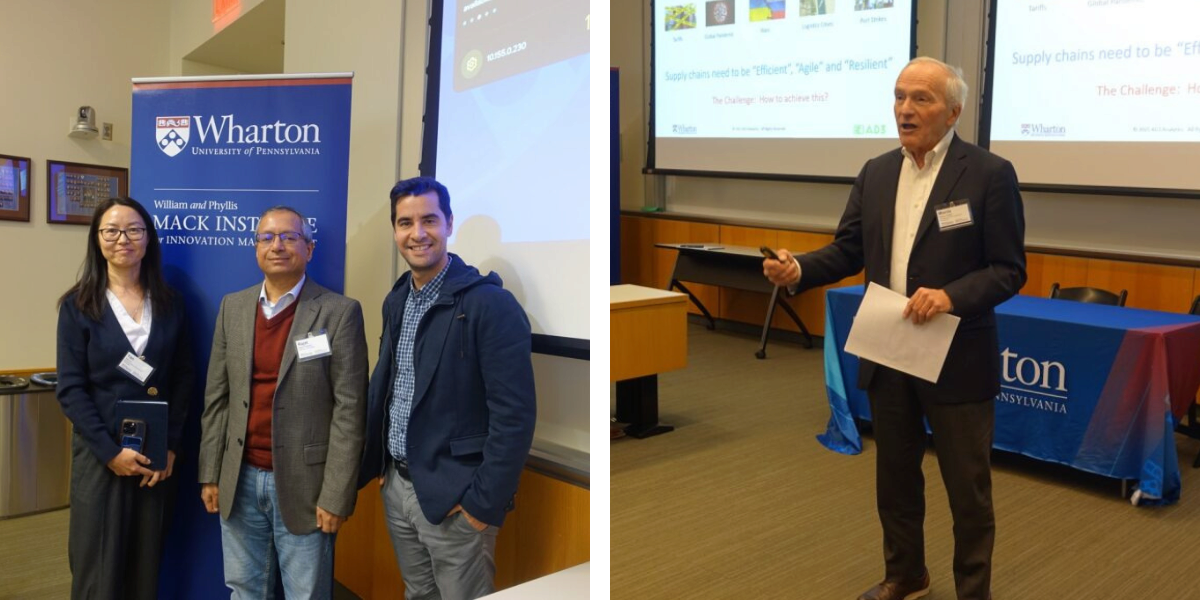
Paris Perdikaris, Associate Professor at Penn Engineering, shared his work on an AI-driven digital twin of the Earth system. It predicts weather and provides insight into storm dynamics, air pollution, and renewable-energy availability. Trained on petabytes of environmental and simulation data, this twin learns the “grammar” of atmospheric and oceanic behavior and delivers forecasts with near-supercomputer accuracy while requiring far less computational cost.
Urban planning and preservation
Chris Bradshaw, Chief Sustainability and Education Officer at Bentley Systems, presented digital twins developed at two different scales: the singular historic structure of Saint Peter’s Basilica and the entire city of Ithaca, New York. The Basilica twin uses a high-fidelity structural model of the 400-year-old cathedral to guide sensor placement and support long-term monitoring. Ithaca’s citywide twin models all 5,200 buildings to assess energy use, rooftop solar potential, and other factors relevant to decarbonization goals. Both twins integrate drone imagery, LiDAR scans, geospatial and building records, and AI-driven modeling to support real-time assessments of structural health and energy performance.
Smart buildings and campuses
Tim McCain, Director of Americas Channel & Industry Development at Mitsubishi Electric/ICONICS Digital Solutions, described how digital twins for smart buildings and campuses create a real-time view of facility performance. These twins unify data from HVAC systems, lighting, occupancy sensors, energy meters, and security devices to support fault detection, comfort management, and operational diagnostics. By harmonizing inputs from diverse vendors and legacy systems, the twin produces an actionable digital representation of the facility that enables efficiency improvements and long-term planning.
Mobility & Autonomy Twins: Modeling Vehicles and Traffic Systems
Digital twins for mobility and autonomous systems were another key focus of the conference. These twins model vehicles, transportation networks, and human movement patterns to support safer autonomy, better urban planning, and more efficient mobility services.
Autonomous vehicle development
Zain Khawaja, Managing Director of Product at the Autoware Foundation, described how open-source digital twins are used to train, test, and validate autonomous vehicles. These AV twins simulate realistic driving environments—including roads, intersections, pedestrians, and weather—while running the algorithms used to test physical vehicles. By enabling millions of virtual scenarios, they allow developers to evaluate safety, refine autonomy stacks, and stress-test decision-making at a scale that would be difficult or unsafe to achieve on public roads.

Mobility-system performance and research
Rajeev Chhajer, Chief Engineer at the Honda Research Institute USA, showed how mobility-system twins can be built to analyze complex transportation networks. His team developed a detailed digital representation of Columbus, Ohio, integrating data from transportation agencies, city planners, transit operators, and Honda’s internal vehicle telemetry. These twins help evaluate congestion, road safety, energy use, and unintended consequences of new technologies—for example, EV charging queues or micromobility behavior. By combining digital road maps with behavioral and operational data, they support “what-if” simulations that inform product development, service planning, and policy decisions.
Connected mobility and communications networks
Rajat Prakash, Senior Director of Technology, Qualcomm, described digital twins used to model large-scale wireless communications networks that support connected and autonomous mobility. These network twins represent entire systems of base stations, devices, and backhaul infrastructure, allowing operators to test capacity planning, failure scenarios, and network performance before making physical investments. By continuously updating the digital model with real-world data, the twin helps engineers evaluate questions such as where new towers are needed, how traffic reroutes during outages, and how changes in network configuration affect service quality. In the context of mobility, these twins play a critical role in ensuring that vehicles, infrastructure, and users remain reliably connected as transportation systems become more data-intensive.
Urban transportation and land-use planning
Erick Guerra, Associate Professor of City and Regional Planning at Penn’s Weitzman School of Design, discussed how urban planners increasingly rely on city-scale transportation models that function as digital twins of travel demand. These systems incorporate city layout, demographic patterns, and activity models to simulate how commuters might respond to changes such as transit expansions, congestion pricing, or the introduction of autonomous vehicles. They enable policymakers to evaluate mobility investments more quickly and with greater analytical confidence.
Industrial Operations & Supply Chain Twins: Optimizing Production, Warehousing, and Global Networks
In factories, warehouses, and global distribution systems, digital twins are used to model how materials, goods, and equipment move through complex operations. By creating dynamic representations of the physical flow of processes and goods, these twins help organizations improve efficiency, reduce downtime, and plan more resilient operations.
Industrial process optimization
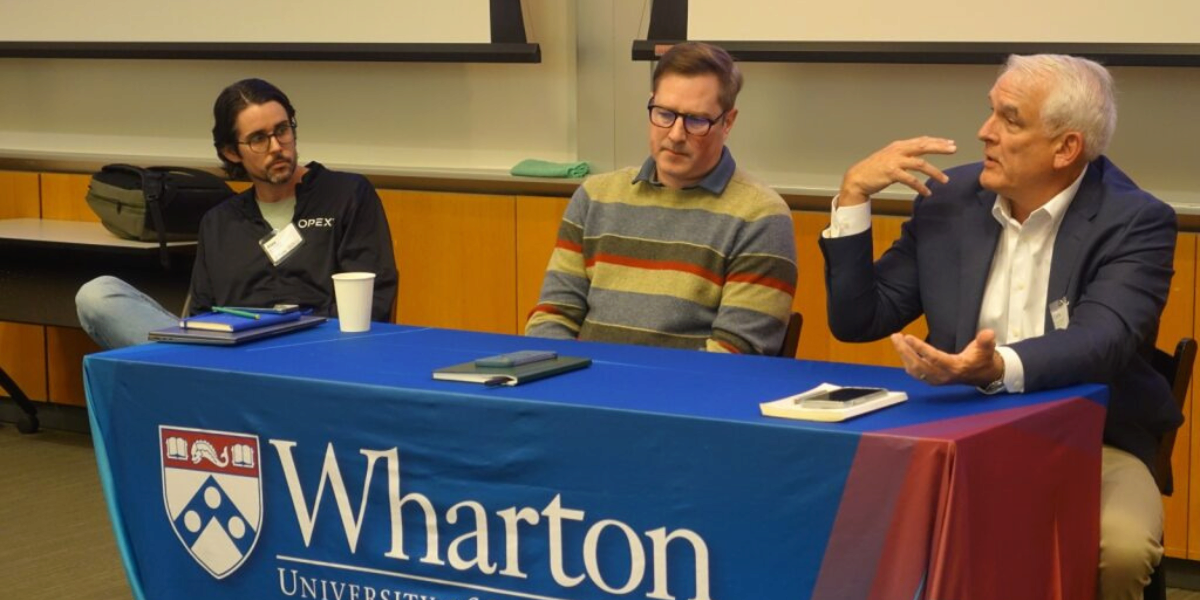
Paul Dooner, Engineering Fellow at Honeywell Process Solutions, described digital twins used in large, continuous manufacturing environments such as refineries, chemical plants, and paper mills. These twins pull together real-time sensor readings and control-system data to show how equipment is running, monitor product quality, and spot early signs of problems. By linking sensing, actuation, and model-predictive control, the system gives operators a clear picture of how production lines react to changing conditions and where adjustments may be needed.
Warehouse automation and robotics
Alex Stevens, President of OPEX Warehouse Automation, explained how digital twins help manage automated warehouse systems that rely on fleets of autonomous robots. These twins simulate how robots move, how bins flow through the system, and how much work each “pick station” can handle, enabling engineers to test layouts and predict performance before anything is built. By modeling how machines, conveyors, racks, and workers interact, the twin helps users spot bottlenecks early, adjust design choices, and run their operations more smoothly.
Global supply chain planning
Morris Cohen, Professor Emeritus at the Wharton School, described supply-chain digital twins that model inventory levels, spare-parts needs, promotional impacts, and potential disruptions across global networks. These twins draw on detailed ERP data and use an “Optimal Machine Learning” approach to connect historical and simulated scenarios directly to recommended decisions. They help companies determine where to place semiconductor spare parts, how to plan for consumer-electronics demand, and how to balance service levels, inventory investment, and resilience under uncertainty.
How Digital Twins Create Value: Pathways to Monetization
Despite the many diverse applications of digital twins, monetization pathways follow a consistent pattern: organizations do not capture value from the twin itself, but from the improved decisions, reduced risks, and operational efficiencies the twin enables. Across industries, several monetization methods appeared repeatedly across the day’s presentations:
Forecasting and Predictive Intelligence
Digital twins power advanced forecasting tools that can be sold as APIs, subscriptions, or enterprise solutions. These predictions create value for sectors such as insurance, agriculture, logistics, mobility, and energy by improving planning horizons and reducing uncertainty.
Examples: weather-risk forecasts for insurers; solar-potential forecasts for cities; traffic-congestion forecasts for mobility operators.
Operational Optimization and Cost Reduction
Twins that monitor or simulate real-world systems help reduce downtime, improve throughput, and increase energy efficiency. Monetization often takes the form of software licenses, systems-integration projects, or performance-based service agreements that share realized savings.
Examples: campus energy optimization; warehouse throughput tuning; refinery process stabilization.
Planning, Scenario Testing, and Capital Allocation
Digital twins support major investment decisions, from retrofits and grid upgrades to layout redesigns and fleet deployment. These insights are typically monetized through consulting engagements, planning-tool subscriptions, or enterprise software platforms.
Examples: building-retrofit planning; EV-charging infrastructure siting; warehouse layout validation.
Risk Management and Compliance
Twins that reveal structural integrity, safety-critical performance, or regulatory exposure create value by reducing organizational risk. Monetization emerges through monitoring services, compliance audits, safety-validation tools, and advisory offerings that help organizations meet regulatory or operational standards.
Examples: structural-health monitoring for heritage buildings; AV safety-scenario testing; supply-chain resilience modeling
Final Takeaways
The conference underscored that digital twins have moved well beyond the experimental stage. They are becoming a necessary tool as organizations are called to manage increasingly complex systems. Across sectors, speakers emphasized that successful digital twins were those that were purpose-built, data-informed, and tightly linked to decision-making, rather than positioned as all-purpose platforms.
“While many challenges face their further implementation, including data governance and validation plus trust-building for better collaboration across functional and organizational boundaries, the learning opportunities are of such a magnitude and scope that we can anticipate more rapid diffusion, particularly as AI supercharges what digital twins can do,” said MacDuffie.
“As we enter 2026, the manufacturing and supply‑chain sectors are facing unprecedented uncertainty,” concluded Rahul Mangharam. “Digital twins are demonstrating tangible value by strengthening organizational performance through rapid response, real‑time learning from shifting market dynamics, and improved multi‑scenario planning. Their tightly integrated, data‑driven architecture has accelerated the transition from digital twins as a promising concept to Digital Twins 2.0, now deeply embedded within the operational fabric of modern enterprises.”