



This report examines how the Department of Defense is integrating Generative AI tools across its vast enterprise. Drawing on insights from defense leaders, industry experts, and academic research, the study presents a framework for assessing AI adoption at scale and highlights the dual-use lessons for the private sector.
With potential productivity gains of up to 17% across military and civilian functions, the report reveals both the opportunities and challenges of deploying Generative AI in one of the world’s most complex organizations and what businesses can learn from this transformation.
Key Findings
Smarter Spending Wins
From discussions with the GenAI and defense community, we heard that allocation of DOD funds matters more than total budget. Internal development and fine-tuning, plus assessing organizational impact (e.g., determining that a $5m tool that supports one team, while a tool equal in cost could be scaled across multiple branches), often yield greater value than vendor acquisition alone.
Efficiency vs. Resilience
Weighing efficiency gains against technological dependency is critical. Once GenAI evaluation concludes, we recommend immediate Red-Teaming to assess impacts on processes. Each scenario should be tested through three lenses: full automation (total dependence on GenAI), collaboration (partial dependence), and abstention (no dependence).
Strategic AI Partnerships
In 2024–2025, major partnerships emerged between defense, tech, and AI leaders—examples include OpenAI with Anduril, Palantir with Shield AI, and Meta with Scale AI. These alliances share key traits:
1. Deep experience in aggregating and synthesizing data for DOD platforms;
2. Access to large-scale datasets and funding to train advanced GenAI systems;
3. Concentrated engineering talent and proven RDT&E cycles for developing foundation models.
Data Rights Dilemma
Data rights remain a core challenge in licensing agreements between AI vendors and the DOD. The DOD holds vast but fragmented datasets, making contracts a balance between security and pricing tied to model training. Vendors must also project how pilot-phase pricing scales to thousands of users. We recommend the DOD invest in durable GenAI contracting practices—backed by funding, labor, and time—to ensure long-term viability for both sides.
Download Report
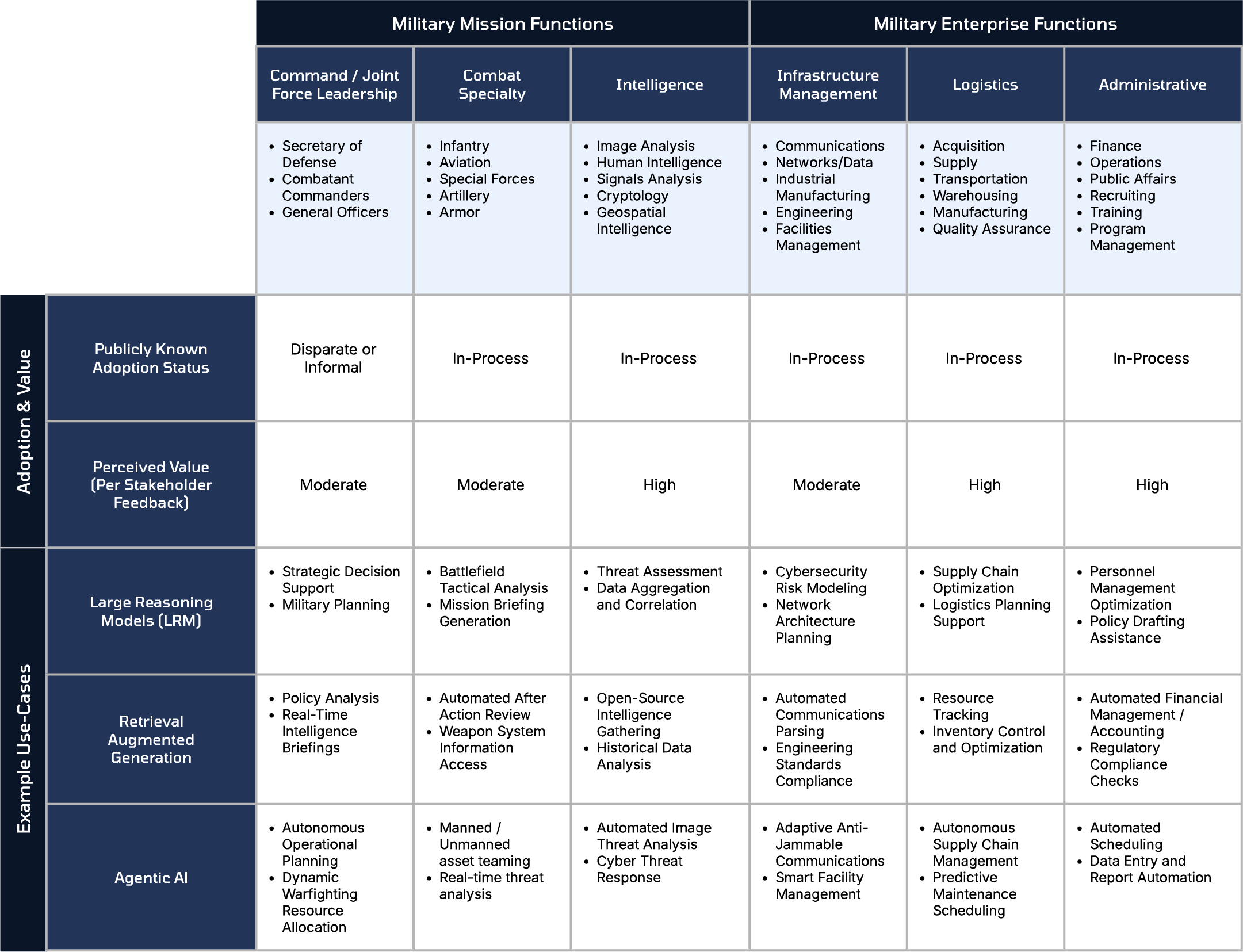
Military AI Use Cases
Authors

Andrew Stiles
Technology Advisor; Emerging Technology and National Security
More
Andrew Stiles advises executives across government and industry on the strategic implementation of emerging technologies. His work spans commercial aerospace, defense, and dual-use innovation, with a focus on helping organizations translate complex technologies—such as AI, autonomy, and digital engineering—into operational capability. He has led and supported deliveries related to critical national security initiatives, including the F-35 sustainment program and next-generation autonomous systems developers. At Deloitte, Andrew helped launch and scale the firm’s space consulting practice, contributing to early client development and program delivery across the public- and private-sector. His perspectives on technology and national security are published by Fast Company, NASA, the Mack Institute for Innovation Management, and various industry journals. Andrew holds an MBA from the Wharton School of the University of Pennsylvania.

Serguei Netessine
Sr Vice Dean for Innovation and Global Initiatives; Professor, the Wharton School
More
Serguei Netessine is the Senior Vice Dean for Innovation and Global Initiatives and the Dhirubhai Ambani Professor of Innovation and Entrepreneurship at the Wharton School. His research focuses on business model innovation and operational excellence, with applications across retail, technology, and aerospace industries. He has advised Fortune 500 organizations and governments. Netessine is a prolific academic with numerous publications in top journals such as Management Science, Operations Research, and Harvard Business Review. He is also the co-author of The Risk-Driven Business Model (Harvard Business Press), which explores how operational choices shape competitive strategy. In addition to his academic work, he is an active angel investor and serves on the advisory boards of several startups.

Conrad Hong
(contributor)
Management Consultant
More
Conrad Hong is a strategy consultant specializing in emerging technologies, with a focus on advancing the adoption and operationalization of defense technology innovations across the DOD and commercial sectors. His work spans aerospace and defense manufacturing, market and competitive analysis, go-to-market strategy, and the deployment of next-generation autonomous systems in support of national security missions. Conrad holds a B.S. in Mechanical Engineering from the University of Maryland and an MBA from Loyola University Maryland.